Posts

Showing posts with the label people

The Death of Code Review (Again)

Image
Almost 3 years ago, in 2023, I wrote a blog post about the death of code review . It hasn't been that long, but software engineering has changed a lot in the last 2 years, and there is a tendency to change even more in 2026. Back in 2023, I was not even talking about AI being the "killer" of code review; it was a series of things: people not paying attention, LGTM without any effort, and a lack of prioritization. So we need to understand that code review was always an important practice, but even without AI, it was already in decline, and people were doing it wrong. Back in 2026, there were even stronger forces pushing code review to die or to change significantly. Most engineers dislike doing code review. I do like code reviews. I found code review useful and an important tool to enforce consistency. However, the disruption with code reviews is inevitable... 

De-Risking

Image
PMI has a whole discipline about risk management. The DevOps movement has several principles to reduce operational risk, such as continuous deployment, infrastructure-as-code, progressive rollout patterns, traffic splitting, and more. Financial institutions might terminate or restrict business relationships with clients and even categories of clients to eliminate risk, hence derisking. Risk management was very popular in the 90s and even 2000s, but it's not dead, IMHO. Nobody talks about risks, nobody even monitors risks. I don't know why that happened or even if it's true for other industries besides technology.  The DevOps movement teaches us many things, one of which is post-mortem or blameless incident reviews. However, incident reviews are great practices if done right, meaning having engineers on the call and actually driving lessons learned for real.  Besides that, the problem is that we are having after the fact, which only prevents feature problems if we do our hom...

Seasons, Injuries, and Rainy Days

Image
Rainy Days Some places have more rain than others. Some cities or regions have rainy seasons; one way or another, rain will happen. Either because it is in the season or because the players are traveling to play, and there is rain where they are right now. 

AI Output

Image
AI Agents and vibing are growing in popularity. It's time for us to think about what use cases make sense to use them and what use cases it would be a mistake to use them. AI is changing how people work, learn, and behave. Should I vibe or not vibe? Vibing can be useful when AI Agents have limits. Vibe coding has several drawbacks, including security challenges, hallucinations, and incorrect facts. However, there are a couple of use cases where vibing can be useful, when: It's not a priority : Imagine there is code that you would never write, tools you would never create, simply because you have bigger priorities and would never spend weeks or months on such tasks. It's not your specialty : Let's say you would never learn C# to make a Windows extension of your application, but with AI Agents or even with vibing, you can get that done without much effort. Limited Resources : You either lack the time or the funds to undertake such a task. AI agents/vibing can allow you to...

Quality and Performance

Image
If you ask any engineer or manager, they will tell you they want quality. No one would say they do not wish to have higher quality. The reality as human beings is that we always want the best. Now, what does quality means? How do we determine if something is of quality or not? How can we learn how to see problems and how can we make things better? Hopefully I will be able to address all these questions in this blog post. In the 1980s there was big quality movement driven by Lean and other methods. Today quality is often misunderstood and took into the the wrong lenses. If you don't understand what quality is, and how good looks like vs how bad looks like, you don't know what's going on, and you certainly cannot make it better. Perspective and vision are everything. This post is not about QA. Having QA also does not guarantee quality. Like security quality is everybody's job. 

No Delay: Leaders Delay Cost a lot

Image
Let me remove the obvious issues before I make my point. Ignoring problems is bad; ignoring problems at scale is even worse. If we have a network effect of ignoring things at scale, that's the worst thing we can do. Ignoring problems leads to Ignoring culture . Being aggressive with problems is not being reckless; it's not about moving so fast that we break things by doing it so. When applying for software, we ask some apparent questions but sometimes forget to apply for people. In software, we don't want to discover all the bugs in production; we want to shift left and find as many problems as possible before going to production. We must apply the shift left to people and address the issues immediately. The sooner we find problems, the sooner we fix them, and the sooner things improve. 

Expectations

Image
Every single day, engineering teams need to do magic. Such magic manifests in several different shapes and forms. It could be by making hundreds of assumptions, figuring out what to do with little to zero context, and delivering decent solutions with proper architecture, design, comprehensive testing, and value via continuous delivery. It's a lot. In reality, most industries use Scrum/SAFE, which is far from the best way to work. In theory, when you are doing Scrum, if you do not finish a story during the spring, it's not a big deal; you go to the next one, shift the stories to the following spring, and it's all good. However, in reality, it is not exactly like that, unfortunately. That happens for various reasons: ignorance of what proper agile looks like, irrational pressure, industry pressure, and hundreds of other uncontrolled and hidden variables. Lean is all about learning to see waste, remove it, optimize it, and improve it with more quality. Companies, unfortunately...

My third book is out: Continuous Modernization

Image
After 7+ months of hard work, my third book is out. Introducing:  Continuous Modernization : The never-ending discipline of improving microservices, monoliths, distributed monoliths, individuals, and teams at scale. Modernization is something I have done over and over in my life. Modernization is something that all companies need and will always need. The need for modernization will never go away, even with LLMs and AI. Technical debt, Anti-patterns, and bad decisions do not take days off. Complexity never shirks and continually grows. Companies do not stop getting bigger and doing more and more software critical to growth, delivering value to customers, and staying competitive and relevant in the market. We need a better way of doing software to drive the best outcomes out of us. Continuous modernization is the counterforce to technical debt and anti-patterns. Continuous modernization is how to continually improve, even when you think it's impossible and nothing can be done. We ca...

Career Frameworks

Image
Today career frameworks are a thing, they are pretty popular along with culture handbooks. Career frameworks are an interesting compass no not only to grow up on a company ladder but also to understand what the culture is and how to be effective. Of course, the paper accepts anything and you might write down beautiful things and have a completely different culture in reality. Besides that the fact that your writing down helps to achieve clarity and spread the word. Especially in REMOTE times like we live today where we have little to zero physical contact. Today I want to comment on 3 career frameworks and also see some similarities and opportunities for us to learn.

Holacracy

Image
Holacracy is an organization system where authority is distributed with self-organizing groups. I first heard about these ideas back in 2013 through Zappos's book . Culture is delicate and often moves much slower than technology. As generations are changing some values are slowly changing. Even COVID-19 is shaping how we live and do business. Holacracy has interesting properties, IMHO is all about the people, having the right talent might work in almost of forms of management systems, of course, the lots of great engineers don't care about what management systems they are in but others do. Today I want to share a slidecast I made sharing some ideas about Holacracy.

Management: The non-obvious II

Image
This is the second post on the series of management the non-obvious. I highly recommend you check out the first post . For the first post, I shared +20 books which was the base of the ideas of the first slidecast. This is the second slidecast. In this second slidecast, we will continue covering some non-traditional ideas and I will recommend +20 books again. Books are portals to other dimensions. We have several cognitive biases in our brains that work against us. We also live in a world that the bad things are repeat over and over and the good things are faiding. So it's really important to spot and think about it. Often we think we have all the answers and just need to execute something, is that so? They allow us to see things we were not seeing before. So I hope you guys like it. Let's get started.

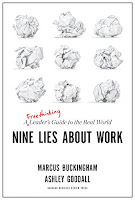
Nine Lies about Work

Image
This is a pretty interesting book. I really love this kind of book where the author challenges the common sense and traditionally established truths that are not so true actually. Work is something we all do and I often think differently about it. Nine Lies about work sound arrogant but actually is not. The book is full of examples and scientific studies and argues very well on the spot. We are living a global pandemic(COVI-19) and that changed all our lives, that shows how fragile we can be. I personally was always into Lean/Agile and never was a fan of traditional management culture. So buckle up this book might shake up you a lot since will challenge traditional things like People to need Feedback. I often like feedback and worked a long time(~11 years) living strong and daily feedback however even that being a strong truth for me, the author managed to show me a different point of view(wit studies of course) and I still like feedback and strong feedback cultures but I see there are...

Attention Economy

Image
Social media is about attention. Real-time chat apps like Messenger, Whatsapp, slack are about attention. 101 meetings are about attention. We live in an attention economy. Everybody whats a time-share of you. A long time ago I disable ALL notifications from Slack, Skype, Whatsapp, Facebook(is closed most of the time of my day) and that is one of the best things you can do too. Not only for your mental health but also to put you in control of your time and therefore your happiness. Interruption is the ultimate killer of deep and meaningful work. However, we also need attention and we might need positive attention much more than feedback(Nine Lies about work).  Humans' attention is a very scarce commodity. I'm not judging anyone: Some people cannot read articles bigger than 5min or videos bigger than 10min. Not for accident Twitter originally had a limit of 140 chars(I miss that :-) ). Attention economy is about information management which threatens human attention as a resourc...

Management: The non-obvious

Image
Traditional management often sucks. Main because the focus is on control, time management, and micro-management. Plus, traditional management does not learn and just repeats the same process repeatedly and expects different results. I prefer modern incarnations like Coaches or even Engineering Managers.  I'm aware that Agile Coaching is a bad word in brazil because of Scams, but it does not mean it is a bad thing - It really depends on the people. People are more attached to managers than you can think. People do not know quite companies, they quite they managers. That's why management is a super important element of companies culture. Companies are complex. Complexity is everywhere; at the same often people just game the system rather than have complex and systemical thinking. So if you want to change the culture, you need to change management., Today, I would like to cover some non-obvious aspects that can deliver a better culture and, therefore, better solutions and better m...

AI and the Future

Image
AI is here to stay. From recommendations to what book read next or what movie or tv show watch next to AI Art generated frames to Self-Driving cars. AI is a powerful technology that we do not master yet. It will bring changes for us as mankind which I'm not sure if we are ready for them. Currently, we have problems understanding WHY ai did something and debug and understand why some outcome happened. This not only is problematic to fight biases but also because we will be doing more complicated things with AI. Today I want to share a simple and short slidecast I made to get you thinking about this. This Slidecast was highly inspired by the books: Life 3.0 and HomoDeus . I also recommend you check out this channel Future of Life Institute and Beneficial AI Panel  and also Sam Harris TED Talk . 

Agile Wasteland

Image
Agile is a wasteland . Don't believe me? Read Kent's Beck(Creator of Extreme Programing) article . IMHO Agile has been in decay since 2013. However, Agile become mainstream since 2000; in Brazil, agile become mainstream in 2015, more or less. Success means misuse. The demand for agile is very high in some countries like Brazil and quite inexistent in Europe and the USA(mainly Silicon valley). Scrum has often sold dogma and easy answers with easy certifications. Scrum is really a big part of agile being mainstrain and also why it is such a shit show. There is so much demand in some places and literally very few people who really understand the software and digital products which greats a very complicated enviroment. So having said that, should we drop agile completely? Well, in some sense, yes. Things we just do because of Dogma and we dont understand and really dont add value should be dropped 100%. However, would all problems just go away? 

House of Cards: System Thinking issue around agile teams

Image
I saw a bunch of things and had several experiences with agile and non-agile teams. This issue is something very usual for new teams or for people that are new with agile culture.  I'm calling this: House of Cards Anti-Pattern or metaphor is you prefer. What you thing about building a house of cards in the top of sand? Sounds like a good idea? We'll that happens a lot - for several reasons.  This metaphor is about people making solutions and decisions in sense of Design and Architecture with zero or poor idea about what the hack they are doing.

Learning: Sometimes is not about fun

Image
We are this idea in IT thats just one kind of learning. This IDEA is wrong. We also associate 100% that FUN = LEARNING. So if we are not having fun? Are we learning? Some people could say no - worst than that - they give up - so if its not FUN i wont pay attention, i wont continue because clearly i`m not learning anything. Some activities like CODING its cool, its fun and for sure you sometimes i dont see the diference between work and fun and learning they all look like the some thing.  Thats amazing but not only with FUN the man lives :-) Most of my BIGGEST learning came from my BIGGEST failures, stress and NOT FUN at all moments. There is no single person in this world that does not suffer. Everybody suffer.  Some people suffer more than another ones but suffering does not make difference between the poor or the rich, the old or the new, the cool or the boring, the manager or the coder.

Drunk Call Anti-Pattern

Image
Have you ever call someone drunk? Often is very bad idea. Everybody can say that, is not even hard to notice. Why is not hard? Simple because everybody knows when you are drunk your could not be yourself actually.  The booze will make you not think straight, will not pay much attention to details, it's easy to loose control and not only make mistakes but loose the ability to do good calls - in other words make right decisions. 

Endurance: The Missing Attitude

Image
Complexity is the center of the universe today. Many things are important to have success and archive great results in life and work. Endurance is a attitude that is missing. Actually when i look people that got great results - all these people had endurance. Good things dont come easy, people talk a lot a about several attitudes now a days like entrepreneurship or creativity but they are focusing on the wrong sides of the attitudes. Nothing great comes fast - So what is the point of sprints? We need test ideas quickly and throw they away right? thats our lean startup FAST FOOD mindset right? I`m saying that wrong but IF you belive in something, in a vision, in a direction you will need endurance.